 NearLife
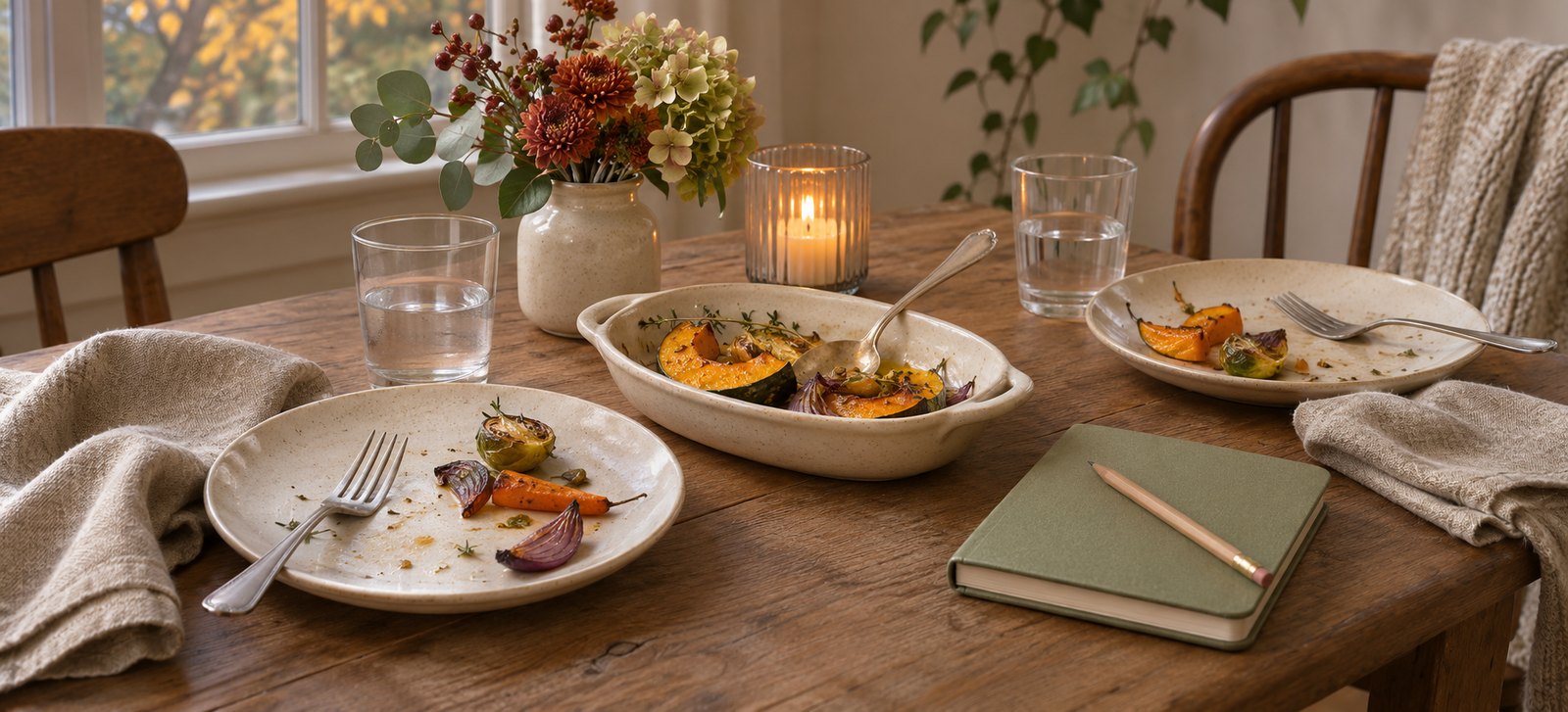
At a holiday table, several things can happen at once: someone passes a favorite dish, a conversation gets louder, and you realize you have hardly noticed your meal. You do not need a perfect record of the evening. One small observation can be enough to remember how it felt.
Keep the gathering in the picture
Mindful eating during the holidays does not have to become another task to complete. For this exercise, the aim is simply to notice one part of your experience and leave a brief note afterward. A Friendsgiving dinner, a work potluck, or a meal with relatives can all be places to begin.
The University of Iowa’s holiday guidance discusses social pressure around food and checking in emotionally at gatherings. Our journaling prompts below are a way to put your own experience into words. They are an invitation to observe, rather than a score for how a meal should go.
Before you arrive, choose one thing to notice
Give yourself a single focus: your mood, your eating pace, or the setting. You might arrive excited to see friends and tired from the trip at the same time. “Excited and worn out” is a useful note; you do not need to settle on one correct feeling.
If it helps, add a word about hunger before the meal. You can keep that detail in a memo alongside your later mood entry. There is no need to assign a number, separate a “real” feeling from a “wrong” one, or decide in advance how much the evening should mean.
During the meal, notice an ordinary moment
Perhaps the roasted squash tastes sweet, you start eating quickly while everyone is serving, or you slow down once the conversation settles. Any one of these is enough. Noticing the whole meal from beginning to end is not a requirement.
You can leave your phone aside while you eat. If you want a photo, take one when it feels comfortable for you and the people at the table. Otherwise, remember a detail and write it down later. A missed photo does not make the experience less worth recording.
Afterward, try this one-minute food and mood journal
Use three short parts: how you felt, how you ate, and what was happening around you. This is a format we propose for a quick personal note; it is not a timed test or a requirement to finish within sixty seconds.
Here is a fictional example, created to illustrate the format: “Friendsgiving with friends. Excited and a little tired. Ate quickly at first, then more slowly while we talked. The room was lively; afterward I wanted a quiet ride home.”
In MealVibe, you can select a mood and note hunger, eating pace, and portion size, then add a memo or photo. Details about arriving tired or feeling different afterward can go in the memo. You can also begin with just “lively table · rushed at first.”
When someone comments on your plate
A remark about another serving or what is on your plate may stay with you more than the food itself. You can record that context without naming the person: “Felt a little on the spot when the conversation turned to portions.”
If you want a phrase ready for the moment, you might try, “That was lovely; I’m happy with what I have for now.” Choose wording that feels natural to you. The journal does not need to prove that you handled the conversation well; it can simply preserve what happened and how it felt.
Look back for context, not a verdict
Later, compare two gatherings rather than judging a single plate. Was one louder? Were you helping serve? Did you arrive after a long day? These details may explain why the meals felt different, without establishing that any one food caused a particular emotion.
You do not need to list every dish. If you remember the evening the next morning, write “remembered afterward” and keep only what you recall. An incomplete note is still a note.
For the next gathering, try one sentence: “What was it like to eat with these people, in this place, today?” Let the answer stay small. It is one moment of your life, and that is enough to begin.